Generations of Parents Warned Kids About Reading in the Dark — Eye Doctors Say There Was Never Anything to Worry About
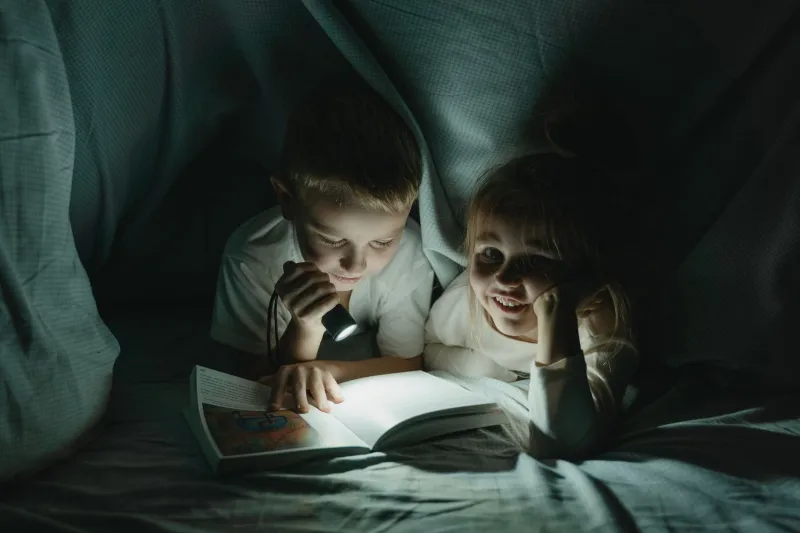
At some point in nearly every American childhood, a parent walks into a bedroom, sees a kid squinting over a book with only a bedside lamp (or a flashlight under the covers), and delivers the warning with absolute certainty: You're going to ruin your eyes doing that.
It's one of those pieces of advice that gets passed down with the confidence of established medical fact. Grandparents said it to parents. Parents said it to kids. Kids grew up and said it to their own children. By now, the idea that dim lighting damages vision has been repeated so many times across so many generations that questioning it feels almost strange — like asking whether ice really is cold.
But here's what the eye doctors have actually found: there is no credible scientific evidence that reading in low light causes any lasting damage to your vision. None. The American Academy of Ophthalmology has said as much. Researchers who have specifically studied the question have come back empty-handed, over and over again.
 Photo: American Academy of Ophthalmology, via static.vecteezy.com
So where did one of the most persistent parenting myths in American history actually come from?
What Your Eyes Actually Do in Low Light
To understand why the myth feels so convincing, it helps to understand what actually happens when you try to read in dim conditions — because something real is going on. It's just not what most people think.
When light is limited, your eyes work significantly harder to focus on text. Your pupils dilate to let in more light. The muscles controlling your lens contract more frequently as your eyes struggle to maintain focus on the page. Over time — say, an hour of reading by a dim lamp — this sustained effort produces genuine fatigue. Eyes feel tired, strained, maybe a little dry. You might get a mild headache. The words might start to blur slightly.
All of that is real. And it's uncomfortable enough that it's easy to understand why early observers concluded something harmful must be happening.
But eye strain and eye damage are completely different things. Tired muscles recover. Strained eyes from an afternoon of reading in poor light feel better after rest, just like sore legs feel better after a long run. The discomfort is temporary. There's no evidence it leaves any lasting mark on the structures of the eye — the retina, the lens, the optic nerve — that would result in permanently degraded vision.
How a Feeling Became a Medical Warning
The roots of this myth stretch back to the early 20th century, when public health messaging around vision was both well-intentioned and considerably less scientifically rigorous than it is today.
In the 1910s and 1920s, concerns about vision health were genuinely prominent in American public discourse. Electric lighting was still relatively new and uneven in quality. Schools were beginning to grapple with how classroom lighting affected students' ability to read. Eye strain was a real and commonly reported complaint, particularly among workers doing close-up tasks in factories and offices with inadequate lighting.
Public health officials and educators of the era responded with warnings about poor lighting that were based on the observable fact that people complained about eye strain in dim conditions. The logical leap — that strain must mean damage — was never rigorously tested. It was assumed. And once it entered the stream of parental advice, it became self-reinforcing in the way that only health warnings can.
By mid-century, the warning had fully detached from its origins and was simply a thing that parents said because their parents had said it. No one was going back to check the original reasoning. The advice had achieved the status of common knowledge, which is often the most durable kind of misinformation — because nobody thinks to question what everybody already knows.
The Research That Should Have Ended This
Ophthalmologists have been pretty clear about this for a long time. Studies examining the actual causes of myopia — nearsightedness, the most common vision problem in children and young adults — have consistently pointed to genetics and, more recently, lack of time spent outdoors as the primary drivers. Reading in general, regardless of lighting conditions, may contribute marginally to myopia development in children who are already genetically predisposed. But the specific variable of low light has not been shown to be the culprit.
A widely cited 2007 survey of common eye myths, published in the British Medical Journal, listed reading in dim light among the misconceptions that had no supporting clinical evidence. The researchers noted that while eye strain is a real phenomenon, there was no demonstrated mechanism by which low light reading would cause structural changes to the eye.
 Photo: British Medical Journal office, via www.angleterrevoyage.com
More recent research into myopia has actually shifted attention in the opposite direction: time spent outdoors, in natural light, appears to be protective against nearsightedness development in children. The recommendation from pediatric ophthalmologists today is less about controlling indoor lighting and more about making sure kids spend time outside — advice that's almost the inverse of the dim-light warning.
Why the Myth Refuses to Retire
Given that the evidence is pretty clear, why does this particular piece of advice keep circulating? A few reasons.
First, the feedback loop is convincing. You read in bad light, your eyes hurt, you stop — and your eyes feel better. That sequence of events feels exactly like "doing damage" and "letting it heal." The fact that you were just tired, not injured, isn't obvious from personal experience.
Second, parents are understandably cautious about anything involving their children's health, and a warning that sounds medical carries weight. Telling a kid to turn on a lamp feels like responsible parenting. Nobody gets criticized for being too careful.
Third — and this is the part that applies to a lot of persistent myths — nobody with financial or institutional incentive has invested in loudly correcting it. Pharmaceutical companies don't profit from debunking parenting folklore. There's no advocacy campaign for dim-light reading rights. So the correction stays in academic journals while the myth keeps circulating at kitchen tables.
The Takeaway
Reading in dim light will make your eyes tired. It might give you a headache. It's genuinely more comfortable to read with adequate lighting, and there's nothing wrong with telling kids to turn on a lamp for that reason alone. But "this is more comfortable" and "this will permanently damage your vision" are very different claims — and only one of them is supported by the evidence. The other one has just been repeated long enough to feel true.